22 March 2026

Ghost Particles – Everything We Know About Neutrinos

Intro: Meet the Universe’s Most Elusive "Ghost"

Hold out your hand for a moment and consider the unseen. In the single second it takes you to read this word, billions of subatomic phantoms have just passed straight through your thumbnail. You didn’t feel them. They left no trace. They are the neutrinos, the universe’s most elusive ghost particles, slipping through the very fabric of our reality as if we are the ones made of nothing.

What exactly is a neutrino? It is a particle defined almost entirely by what it lacks. Devoid of an electric charge, it feels no compulsion to interact with the electromagnetic fields that bind our physical world together. For decades, we believed they lacked mass entirely, mere whispers of energy. They interact with our world solely through gravity and the "weak force," an interaction so phenomenally rare that a neutrino could journey through a solid block of lead a light-year thick and never once brush against an atom. 

Yet, for all their aloofness, they are infinitely complex shape-shifters. Neutrinos exist in three distinct "flavors"—the electron neutrino, the muon neutrino, and the tau neutrino. As they hurtle through the cosmos, they perform a quantum dance known as oscillation, spontaneously morphing from one flavor to another mid-flight. To study the neutrino is to study a mirage that constantly reinvents itself.

History: A "Desperate Remedy" and "Project Poltergeist"

To understand how we came to know the unknowable, we must look back to 1930, when Wolfgang Pauli realized the mathematics of beta decay were broken. Energy was disappearing into the void, violating the most sacred laws of physics. In what he famously called a "desperate remedy," Pauli literally invented a particle out of thin air to balance his equations. It was an intellectual "my bad"—a ghost conjured to save physics from collapse. By 1933, Enrico Fermi had woven this ghost into formal theory, bestowing upon it the moniker *neutrino*, Italian for the "little neutral one."

But how do you catch a ghost? In 1956, Clyde Cowan and Frederick Reines set up a trap near a nuclear reactor at the Savannah River Site. Aptly named "Project Poltergeist," their experiment finally captured the phantom, proving Pauli’s desperate remedy was terrifyingly real and earning Reines a belated Nobel Prize in 1995.

Yet, the mystery only deepened. For decades, solar physicist Ray Davis stared into the abyss of the "Solar Neutrino Problem," bewildered as to why two-thirds of the neutrinos expected from our Sun simply went missing before reaching Earth. It wasn't until the turn of the millennium that the Super-Kamiokande and Sudbury Neutrino Observatory (SNO) solved the riddle: the neutrinos weren't missing; they were oscillating. And to oscillate, the rules of quantum mechanics dictate they *must* have mass. The ghost had weight.

Modern Times: Mapping the Milky Way with Ghosts

Today, we are no longer just hunting these phantoms; we are using them as a lens to perceive the cosmos. We have entered an era of high-energy snapshots and staggering scales. In 2023 and 2024, the FASER and SND@LHC experiments at the Large Hadron Collider captured "collider neutrinos" at TeV (teraelectronvolt) energy scales—the highest-energy man-made neutrinos ever observed.

Our vision of the cosmos is transforming. Recently, the IceCube Neutrino Observatory, buried deep in the Antarctic ice, looked up and captured the first-ever image of the Milky Way. But it wasn't a map woven of starlight; it was a map woven of ghost particles, proving our galactic plane is a bustling highway of high-energy neutrinos. 

Then came the staggering PeV speed record. Between 2023 and 2026, the KM3NeT detector, submerged in the Mediterranean Sea, caught the wake of a neutrino carrying an apocalyptic energy of 220 PeV (petaelectronvolts)—over ten times the previous record. How can something so energetic weigh so little? The KATRIN experiment has recently played the ultimate game of weight watchers, pushing the absolute upper limit for the electron neutrino’s effective mass down to a mere 0.45 eV. It is a paradox of nature: a particle carrying shattering cosmic energy, yet weighing at least a million times less than an electron.

Theoretical Tea: Are Neutrinos Why We Exist?

When you stare deeply enough into the nature of the neutrino, you inevitably brush up against the existential. Are these little neutral ones the very reason we are here to observe them? 

Consider the "Hierarchy Debate." Physicists are currently locked in a profound effort to understand the mass ordering of these three flavors. Does the universe prefer a "Normal" hierarchy (two light states and one heavy) or an "Inverted" one? The recent joint data from the T2K and NOvA experiments favor the Normal camp by odds of 7-to-1, hinting at a deep underlying structure to reality that we are only just beginning to decipher.

More tantalizing is the concept of "Antime"—the study of Charge-Parity (CP) violation. Evidence is mounting that neutrinos and antineutrinos do not behave as perfect mirrors of one another. This slight asymmetry, this microscopic rebellion against the rules of antimatter, might just be the reason our universe is filled with galaxies, stars, and biological life, rather than being an empty, sterile void of self-annihilated energy. 

Then there is the Majorana Mystery. What if the neutrino is its own antiparticle? If experiments like KamLAND-Zen—which currently constrain this theoretical Majorana mass to a ghostly 10 to 100 meV—prove this true, it implies a beautiful, haunting symmetry. It would mean the neutrino is a particle perfectly unto itself, capable of annihilating its own kind, a cosmic ouroboros.

The Drama: Particle Physics Fight Club

Of course, the edges of human knowledge are fraught with friction. The neutrino does not give up its secrets without a fight, leading to anomalies that threaten to tear down the Standard Model.

Take the "Sterile Neutrino Crisis." For years, experimental ghosts haunting the MiniBooNE and LSND detectors suggested a "fourth flavor" of neutrino that interacts with absolutely nothing—not even the weak force. While recent data from MicroBooNE (2021–2026) ruled out the simplest sterile models, the original data excess refuses to vanish. We are left arguing over non-standard interactions we cannot yet comprehend.

Then there is the Gallium Anomaly, a mathematical headache where the BEST experiment confirmed a deficit in neutrinos at a staggering 5-sigma significance. By 2026, KATRIN had ruled out the sterile neutrino as the culprit. We are left staring at a statistically undeniable phenomenon with zero theoretical explanation.

The detectors themselves seem to be at war. The 220 PeV leviathan observed by KM3NeT was inexplicably missed by the much larger IceCube detector. Did KM3NeT merely catch a glitch, or did it witness a "ghost resonance" as the particle passed right through the Earth’s molten core? 

Add to this the Cosmology Conflict: laboratory measurements place the neutrino mass limit at 0.45 eV, yet cosmological models of the universe’s expansion ($\Lambda$CDM) insist the sum of all neutrino masses cannot exceed 0.12 eV. The telescopes and the laboratories are telling us two different stories about the fundamental fabric of reality.

Looking Ahead: The "Precision Era" of Ghost Hunting

We stand on the precipice of a new epoch. The wild west of particle discovery is giving way to the "Precision Era" of ghost hunting, fueled by cathedrals of subterranean science.

In the early 2030s, the Deep Underground Neutrino Experiment (DUNE) will unleash "The Big Beam," firing a concentrated stream of neutrinos 1,300 kilometers straight through the solid rock of the Earth, from Illinois to South Dakota, to watch them oscillate in unprecedented, high-fidelity detail.

Meanwhile, the Hyper-Kamiokande (Hyper-K) will come online in 2027. Eight times larger than its legendary predecessor, this giant watchman will sit in the dark, waiting for a star in our galaxy to die, ready to catch the deluge of neutrinos a supernova exhales before its light ever reaches Earth.

We are actively trying to rewrite the rulebook. Upcoming marvels like the JUNO reactor experiment in China, aiming to definitively lock down the mass hierarchy, and LEGEND-1000, a ton-scale search for neutrinoless double-beta decay, carry the potential to shatter our current physics. If LEGEND-1000 proves the Majorana nature of the neutrino, we will have to throw out the Standard Model and begin anew.

Conclusion: The Smallest Particle with the Biggest Answers

There is a profound poetry in the physics of the neutrino. We are a species bound to the heavy, tangible matter of our world, yet we are driven to understand a particle that barely grazes the edges of existence. 

These "little neutral ones," possessing a mass so near to nothing it defies imagination, hold the answers to the vastest questions of cosmology. They are the keys to the next century of science—a silent, invisible symphony passing through our fingertips, holding the secrets to why the universe exists at all. And the most thrilling part? We are only just getting started.


28 July 2025

Your New Coding Buddy: How AI is Revolutionizing Web Apps!


I. Introduction: Remember Manual Coding? Say Hello to Your New AI Co-Pilot! 

The days of painstakingly writing every line of code might be fading faster than dial-up internet. I remember spending countless hours debugging a single semicolon error, a Sisyphean task that felt both crucial and utterly pointless. Now, the landscape is shifting. AI isn't just for chatbots and image generators anymore; it's stepping into the developer's chair, making web app creation faster, smarter, and more accessible. The implications are profound, touching not just the speed of development but also the very nature of the developer's role. From generating entire websites from a simple prompt to squashing bugs with uncanny precision, AI is changing the game, prompting us to reconsider what it means to build for the web. 

II. A Whirlwind Tour Through Time: AI's Journey in Web Development 

The Early Days (Before the Buzz): The genesis of AI's involvement in web development, if we can call it that, stretches back surprisingly far. Think back to the intellectual ferment of the 1950s – Turing, McCarthy, the very idea of Artificial Intelligence. Back then, it was largely theoretical, a philosophical puzzle rather than a practical tool for crafting web applications. The subsequent decades, from the 1960s to the 1990s, witnessed the emergence of primitive code generation techniques, things like compiler compilers that automated the creation of compilers, or template-based tools that offered a modicum of pre-built structure. But these were mere glimmers of what was to come, early, rudimentary attempts to automate away the more tedious aspects of coding. It wasn't until the early 2000s that machine learning began to infuse code generation with a degree of actual intelligence, enabling systems to learn from data and adapt their output accordingly. 

The "AI Boom" Arrives (Early 2020s and Beyond): The true revolution began with the explosion of neural networks and transformer architectures in the early 2020s. Suddenly, we had models like GPT-3 and OpenAI's Codex, capable of feats of natural language understanding and code synthesis that were previously unimaginable. 2021 marked a pivotal moment with the release of GitHub Copilot, a tool that offered real-time, context-aware code suggestions, functioning as a veritable "AI pair programmer." This wasn't just simple auto-complete; it was AI understanding the intent behind your code and offering intelligent suggestions to complete it. We moved rapidly from simple assistance to systems capable of generating full-stack applications from plain English descriptions – the era of design-to-code and full-stack generation had truly arrived. 


III. Devs Spill the Beans: The Good, The Bad, and The Code Generated by AI 

The Bright Side: Why Developers Are (Mostly) Loving It The allure of AI in web development is undeniable, and it stems from tangible benefits that developers are experiencing firsthand. Productivity is the headline here. Imagine finishing tasks 55.8% faster! It is not surprising that a staggering 92% of US developers are already incorporating AI tools into their workflows. But beyond raw speed, there's a deeper satisfaction at play. Developers report experiencing less mental effort on repetitive tasks (a 70% reduction!), and spending less time searching for solutions (a 54% reduction!). This translates to happier coders. Approximately, 90% feel more fulfilled in their roles. Moreover, AI contributes to cleaner, leaner code by flagging errors, suggesting best practices, and even automating the creation of tests. And for junior developers, AI serves as an invaluable learning tool, providing real-time guidance and accelerating their understanding of complex concepts. 

The Not-So-Glamorous Side: Controversies and Concerns 

However, the integration of AI into web development is not without its challenges and controversies. It's crucial to acknowledge the potential downsides and address them proactively. 

 "Helpful or Hindering?" – The Skill Erosion Debate: One of the most frequently voiced concerns is the potential for skill erosion. Are we becoming overly reliant on AI, potentially sacrificing our critical thinking and problem-solving abilities? It's a valid question that requires ongoing self-reflection and a conscious effort to maintain our core competencies. 

"Is that code even good?" – Quality and Accuracy Headaches: The quality and accuracy of AI-generated code are also sources of concern. AI can produce verbose, inefficient, or even incorrect code ("hallucinations," as they're sometimes called, where the AI suggests non-existent packages or functions). Human review remains essential to ensure the code meets the required standards. 

"Who Owns This Masterpiece?" – Intellectual Property Nightmares: The legal implications of AI-generated code are murky. Who owns the copyright to code created by an AI? The training data used to develop these AI models often contains copyrighted material, raising the specter of infringement risks ("license contamination"). 

"Security Scare!" – Vulnerabilities in AI's Code: Security vulnerabilities are another significant worry. AI can inadvertently reproduce insecure coding practices from its training data, potentially introducing weaknesses into our applications. Studies have indicated that as much as 40% of AI-generated code may contain vulnerabilities, leading to a false sense of security among developers. 

"Are Robots Taking Our Jobs?" – Job Displacement vs. Evolution: Job displacement is perhaps the most anxiety-inducing concern. It's clear that routine coding tasks are at risk of automation. However, the majority of developers (70%) view AI as an augmentation of their abilities rather than a direct replacement. The role of the developer is evolving, shifting from writing every line of code to orchestrating AI and focusing on higher-level architecture, ethical considerations, and creative problem-solving. 

Beyond the Code: Creativity and Nuance: Finally, it's important to remember that AI still struggles with true originality, understanding complex business logic, or effectively guiding human clients who may not have a clear vision of what they want. These areas require uniquely human skills of creativity, empathy, and nuanced communication. 


IV. The Crystal Ball: What's Next for AI in Web Development? 
Gazing into the future, the trajectory of AI in web development points towards even more profound transformations. 

Autonomous Agents Go Wild: Imagine AI agents that can independently plan, code, debug, and deploy entire applications with minimal human intervention. We're already seeing early examples of this with tools like Bolt.new and Google Jules. 

Hyper-Personalization on Steroids: Websites will become incredibly attuned to individual user preferences, dynamically adjusting content, layouts, and recommendations based on every interaction. 

Design Gets Even Smarter: AI tools will be able to translate design ideas, sketches, or even natural language prompts into functional, responsive user interfaces, bridging the gap between design and development.

Fort Knox Security & Peak Performance: AI will continuously monitor web applications, predict and mitigate security threats, and optimize performance and SEO in real-time, ensuring optimal user experience and security. 

New Tools on the Block: Innovations such as CodeGPT, Amazon Q Developer, and advanced AI IDEs like Windsurf are poised to reshape the development landscape, offering developers unprecedented capabilities. The Evolving Developer: In this future, the developer's role will shift from being a coder to becoming an "orchestrator" of AI, focusing on high-level architecture, ethical considerations, and creative problem-solving. 


V. Conclusion: The Human-AI Partnership – Building the Future of the Web, Together! 
AI in web development is a transformative force, offering unprecedented efficiency and opening up new possibilities for innovation. It's not about AI replacing humans, but about forging a new era of collaboration. Your AI co-pilot is here to stay, making development more exciting and impactful than ever before. The future of the web is not one built solely by machines, but one crafted through the synergy of human ingenuity and artificial intelligence, a partnership that promises to redefine the boundaries of what's possible.

03 February 2025

Can You Run an LLM on Your Phone?

How I installed DeepSeek on my phone with surprisingly good results
Here's how you can run AI locally on your smartphone too.
By Robert Triggs
February 1, 2025

01 February 2025

Deepseek's Janis Pro

The introduction of DeepSeek Janus has generated significant interest and a wealth of commentary. Vedang Vatsa FRSA shared:

DeepSeek’s Janus-Pro-7B is here. Outperforms DALL-E 3 & Stable Diffusion on GenEval/DPG-Bench. Separates understanding/generation, scales data/models for stable image gen. Unified, flexible, cost-efficient. Open-source win!.

And, AI expert Huzaifa Shoukat posted:

DeepSeek's new Janus Pro model is impressive. It's a multimodal LLM that understands images and generates them too. The 1B model runs in the browser using WebGPU via Transformers.js.

 * While Janus-Pro's source code is freely available on GitHub under the MIT License, it's important to note that the DeepSeek Model License governs how you can use the model. Setup instructions are provided in the repository.

DeepSeek is headquartered in Hangzhou, China and was founded in 2023 by Liang Wenfeng, who also launched the hedge fund backing DeepSeek.

29 January 2025

Deepseek, NVDIA, and the Future of AI

The way the stock market has responded in the price drop for Nvidia (NASDAQ: NVDA) and related chipmaker stocks after the news of the Chinese (Deepseek) advance in AI using cheaper hardware is exactly how markets are supposed to work. Regardless of the news of the day, this should be good news for everyone that our markets are healthy and that they're responding appropriately.

21 January 2025

Microsoft Renames Office to "Microsoft 365 Copilot"

This just in from XDA:

By Simon Batt - 3 days ago

## Microsoft 365 Copilot: The AI-Powered Productivity Revolution

In a bold move that signals the future of workplace technology, Microsoft has transformed its iconic Office suite into Microsoft 365 Copilot, marking a significant milestone in the company's AI journey.

### What's Changing?

Gone are the days of the familiar blue hexagon logo. Microsoft is now sporting a sleek Copilot-inspired brand identity that screams innovation. But this isn't just a cosmetic change – it's a fundamental reimagining of productivity tools.

### More Than Just a Rebrand

Microsoft isn't merely changing names; they're integrating AI deeply into every aspect of their productivity ecosystem. Copilot is no longer an add-on – it's now a core feature across Word, Excel, PowerPoint, and Teams.

### The Price of Progress

For the first time in 13 years, Microsoft 365 subscribers will see a price increase. While some might balk at the cost, the AI-powered features promise to dramatically enhance workplace efficiency.

### Beyond Microsoft's Ecosystem

The Copilot revolution isn't stopping at Microsoft's borders. Partnerships with companies like LG and Samsung are bringing AI assistants to smart TVs, suggesting a broader vision of interconnected, intelligent technology.

### The Community Speaks

Reactions are mixed. Tech enthusiasts are excited about the AI potential, while traditionalists worry about over-reliance on artificial intelligence. Sound familiar? It's the classic technology adoption curve.

### Looking Ahead

Is this Microsoft's definitive AI strategy, or will Copilot join the ranks of forgotten tech initiatives like Cortana? Only time will tell.

Stay tuned, stay curious, and get ready for an AI-powered productivity transformation.


Here's the link: https://www.xda-developers.com/microsoft-renamed-office-everyones-pcs/

11 December 2024

Wolfram Language

Here's a snippet from the book:

The Wolfram Language seems too easy; is it really programming?
Definitely. And because it automates away the drudgery you might associate with programming, you’ll be able to go much further, and understand much more.

New Quantum Algorithms Finally Crack Nonlinear Equations | Quanta Magazine

Listen to an AI podcast on this article:

New Quantum Algorithms Finally Crack Nonlinear Equations
Max G. Levy
January 5, 2021

Two teams found different ways for quantum computers to process nonlinear systems by first disguising them as linear ones.
Read Later

Olena Shmahalo/Quanta Magazine
Sometimes, it’s easy for a computer to predict the future. Simple phenomena, such as how sap flows down a tree trunk, are straightforward and can be captured in a few lines of code using what mathematicians call linear differential equations. But in nonlinear systems, interactions can affect themselves: When air streams past a jet’s wings, the air flow alters molecular interactions, which alter the air flow, and so on. This feedback loop breeds chaos, where small changes in initial conditions lead to wildly different behavior later, making predictions nearly impossible — no matter how powerful the computer.

“This is part of why it’s difficult to predict the weather or understand complicated fluid flow,” said Andrew Childs, a quantum information researcher at the University of Maryland. “There are hard computational problems that you could solve, if you could [figure out] these nonlinear dynamics.”

That may soon be possible. In separate studies posted in November, two teams — one led by Childs, the other based at the Massachusetts Institute of Technology — described powerful tools that would allow quantum computers to better model nonlinear dynamics.


Quantum computers take advantage of quantum phenomena to perform certain calculations more efficiently than their classical counterparts. Thanks to these abilities, they can already topple complex linear differential equations exponentially faster than classical machines. Researchers have long hoped they could similarly tame nonlinear problems with clever quantum algorithms.

The new approaches disguise that nonlinearity as a more digestible set of linear approximations, though their exact methods vary considerably. As a result, researchers now have two separate ways of approaching nonlinear problems with quantum computers.

“What is interesting about these two papers is that they found a regime where, given some assumptions, they have an algorithm that is efficient,” said Mária Kieferová, a quantum computing researcher at the University of Technology Sydney who is not affiliated with either study. “This is really exciting, and [both studies] use really nice techniques.”

The Cost of Chaos
Quantum information researchers have tried to use linear equations as a key to unlock nonlinear differential ones for over a decade. One breakthrough came in 2010, when Dominic Berry, now at Macquarie University in Sydney, built the first algorithm for solving linear differential equations exponentially faster on quantum, rather than on classical, computers. Soon, Berry’s own focus shifted to nonlinear differential equations as well.

“We had done some work on that before,” Berry said. “But it was very, very inefficient.”

Photo of Andrew Childs standing in front of a white board full of math
Andrew Childs, of the University of Maryland, led one of two efforts to allow quantum computers to better model nonlinear dynamics. His team’s algorithm turned these chaotic systems into an array of more understandable linear equations using a technique called Carleman linearization. John T. Consoli / University of Maryland
The problem is, the physics underlying quantum computers is itself fundamentally linear. “It’s like teaching a car to fly,” said Bobak Kiani, a co-author of the MIT study.

So the trick is finding a way to mathematically convert a nonlinear system into a linear one. “We want to have some linear system because that’s what our toolbox has in it,” Childs said. The groups did this in two different ways.

Childs’ team used Carleman linearization, an out-of-fashion mathematical technique from the 1930s, to transform nonlinear problems into an array of linear equations.

Unfortunately, that list of equations is infinite. Researchers have to figure where they can cut off the list to get a good-enough approximation. “Do I stop at equation number 10? Number 20?” said Nuno Loureiro, a plasma physicist at MIT and a co-author of the Maryland study. The team proved that for a particular range of nonlinearity, their method could truncate that infinite list and solve the equations.

The MIT-led paper took a different approach. It modeled any nonlinear problem as a Bose-Einstein condensate. This is a state of matter where interactions within an ultracold group of particles cause each individual particle to behave identically. Since the particles are all interconnected, each particle’s behavior influences the rest, feeding back to that particle in a loop characteristic of nonlinearity.

The MIT algorithm mimics this nonlinear phenomenon on a quantum computer, using Bose-Einstein math to connect nonlinearity and linearity. So by imagining a pseudo Bose-Einstein condensate tailor made for each nonlinear problem, this algorithm deduces a useful linear approximation. “Give me your favorite nonlinear differential equation, then I’ll build you a Bose-Einstein condensate that will simulate it,” said Tobias Osborne, a quantum information scientist at Leibniz University Hannover who was not involved in either study. “This is an idea I really loved.”

A colorful computer model of a Bose-Einstein condensate against a black background
The MIT-led team’s algorithm modeled any nonlinear problem as a Bose-Einstein condensate, an exotic state of matter where interconnected particles all behave identically.

NIST

Berry thinks both papers are important in different ways (he wasn’t involved with either). “But ultimately the importance of them is showing that it’s possible to take advantage of [these methods] to get the nonlinear behavior,” he said.

Knowing One’s Limits
While these are significant steps, they are still among the first in cracking nonlinear systems. More researchers will likely analyze and refine each method — even before the hardware needed to implement them becomes a reality. “With both of these algorithms, we are really looking in the future,” Kieferová said. Using them to solve practical nonlinear problems requires quantum computers with thousands of qubits to minimize error and noise — far beyond what’s possible today.

And both algorithms can realistically handle only mildly nonlinear problems. The Maryland study quantifies exactly how much nonlinearity it can handle with a new parameter, R, which represents the ratio of a problem’s nonlinearity to its linearity — its tendency toward chaos versus the friction keeping the system on the rails.

“[Childs’ study is] mathematically rigorous. He gives very clear statements of when it will work and when it won’t work,” Osborne said. “I think that’s really, really interesting. That’s the core contribution.”

The MIT-led study doesn’t rigorously prove any theorems to bound its algorithm, according to Kiani. But the team plans to learn more about the algorithm’s limitations by running small-scale tests on a quantum computer before moving to more challenging problems.

The most significant caveat for both techniques is that quantum solutions fundamentally differ from classical ones. Quantum states correspond to probabilities rather than to absolute values, so instead of visualizing air flow around every segment of a jet’s fuselage, for example, you extract average velocities or detect pockets of stagnant air. “This fact that the output is quantum mechanical means that you still have to do a lot of stuff afterwards to analyze that state,” Kiani said.

It’s vital to not overpromise what quantum computers can do, Osborne said. But researchers are bound to test many successful quantum algorithms like these on practical problems in the next five to 10 years. “We’re going to try all kinds of things,” he said. “And if we think about the limitations, that might limit our creativity.”


15 August 2024

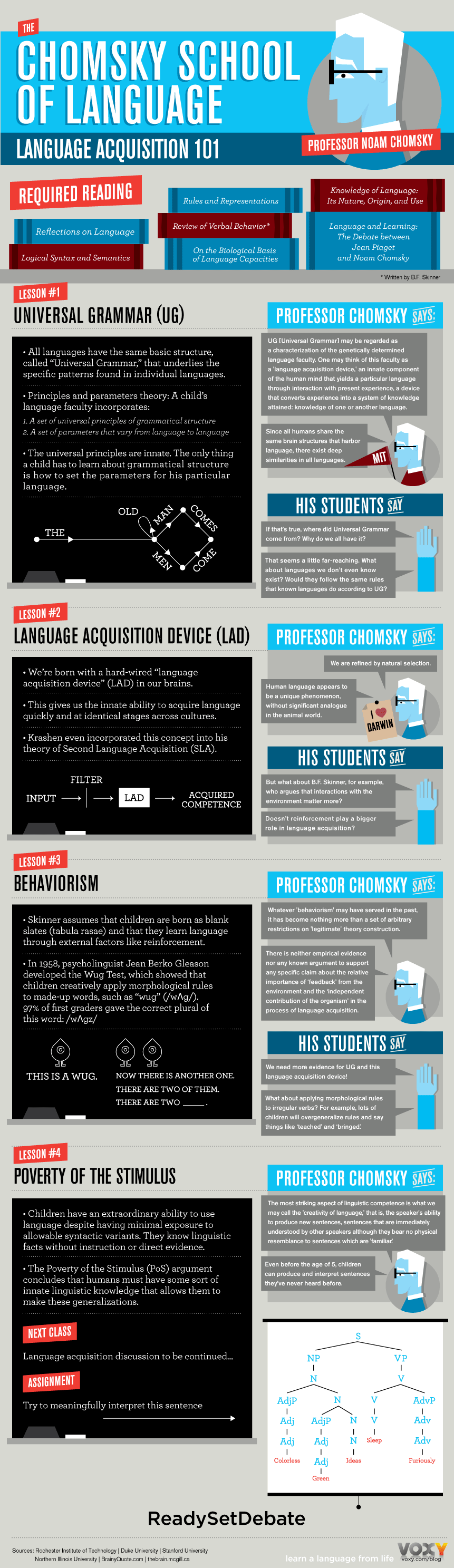
The Chomsky School of Language Infographic

 Language and linguistics is a broad topic, but there is a practical approach to mastery: 

Here it is: The Chomsky School of Language Infographic

13 October 2023

Being good enough at something to make a living at it is always a challenge

A recent article on DEV [DEV Community is a community of 1,164,769 amazing developers], entitled, "Unpopular Opinion: It’s harder than ever to be a good software engineer," is about what adds value when it comes to software engineering. 

Many of the points made can be applied to virtually any profession. For instance, journalism. Journalists also have to write; instead of writing code they're writing articles. But being a good journalist, that is good enough to make a living doing it, is not so easy.

15 April 2023

Words From a Savvy Technocrat

"If lucid and rivian don’t change things as soon as possible they will go bankrupt. Getting volume production and profitability is insane to make happen. That’s why what Tesla did is 🤯🤯🤯 @elonmusk"

https://twitter.com/teslaownersSV/status/1646738351742140417?t=mRXOeVbpk8hCuSVctpEi9w&s=19

14 September 2021

03 June 2021

Tip: Google can read out loud almost any story on your Android phone

When you invoke the Assistant while looking at an article and say something like "Read it," "Read this page," or "Read it to me," it will give you an audiobook version of the content you're seeing. You can even try that with the text right here.


17 February 2021

Enterprise Data Warehouses (EDWs): Economics, Deployment, and Maintenance

  • AWS Redshift: the size and quantity of the instances required to handle ingest and workload must be predicted. 
  • Microsoft Azure SQL DW: users must choose the cDWU rating that best meets their needs. 
  • Snowflake users must determine the mix of storage and the size of the virtual data warehouse that best suits the needs of each business unit as well as for a dedicated warehouse used for loading data.
  • BigQuery: customers do not have to plan and size the configuration to meet their needs. BigQuery is completely serverless and customers do not have to plan or adjust the supporting infrastructure.


12 May 2020

Ask the Global 30

The following is an excerpt from an article in Portrait, an online magazine (link below)
(Interviewer is Yang Lu)
https://www.brockmanmedia.com/portraitmagazine-jan2018-global30

P: The annual question of 2017 is “What scientific term or concept ought to be more widely known?” Why did you choose this question?

B: Richard Dawkins' “meme” became a meme, known far beyond the scientific conversation in which it was coined. It’s one of a handful of scientific ideas that have entered the general culture, helping to clarify and inspire. This question recognizes that there were many terms that clarify and inspire serious thinking.

On the other hand, not everyone likes the idea of spreading scientific understanding. Remember what the Bishop of Birmingham’s wife is reputed to have said about Darwin’s claim that human beings are descended from monkeys: "My dear, let us hope it is not true, but, if it is true, let us hope it will not become generally known."

P: What’s your answer about this question?

B: I have no answers. The question is the answer. Or, a better way of putting this: I am the guy who stands at the back of the theatre and turns the lights on and off.

P: What have you learned from this particular question?

B: Some of the most interesting topics included: Mysterianism (Nicholas G. Carr), Confirmation Bias (Brian Eno), Affordances (Daniel C. Dennett), Common Sense (Jared Diamond), Deliberate Ignorance (Gerd Gigerenzer), Intellectual Honesty (Sam Harris), The Neural Code (John Horgan), Neurodiversity (Joi Ito), The Anthropocene (Jennifer Jacquet), Premature Optimization (Kevin Kelly), Naïve Realism (Matthew D. Lieberman), Navier-Stokes Equations (Ian McEwan), The Second Law of Thermodynamics (Steven Pinker), Effective Theory (Lisa Randall), Haldane's Rule of the Right Size (Paul Saffo), Epsilon (Victoria Stodden), Coalitional Instincts (John Tooby), Embodied Thinking (Barbara Tversky).